
review by José Angel Araguz
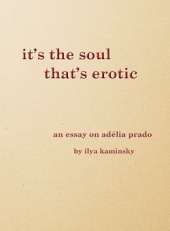
Early in his essay-turned-chapbook it’s the soul that’s erotic: an essay on adélia prado (Orison Books), poet Ilya Kaminsky speaks of Adélia Prado’s work as being in the mystic tradition. He then promptly delves into the questions and assumptions that come along with references to mysticism. Noting that “the term mystic may mislead or intimidate,” Kaminsky goes on to argue that mystical experience, far from being something “attainable only by a few human beings,” is actually “always available, and to anyone.”
This opening note on mysticism’s accessibility and ubiquity quickly frames his analysis on Prado’s work within an argument that feels familiar within poetry circles. Replace the word mystic with poetry in the above statements and one finds the divide to be similar; both mysticism and poetry are regarded with mistrust by some non-practitioners (not to say non-believers), a mistrust that ranges from veiled skepticism regarding the respective value of each, to outright dismissal. To push this comparison further, mystics and poets are equally defined by practice: a mystic is only a mystic when voicing their spiritual truth, and a poet can only be called so via the creation of a poem. Or, to put it another way, the poet is by no means an embodiment of poetry any more than a mystic is the embodiment of truth: both are fingers pointing to the moon.
Navigating this fine line between the ineffable and the practical is not only the work of the mystic and poet, but also of the critic. Kaminsky does a great job throughout this short essay of establishing a sense of the traditions Prado’s work is in line with, both mystically and poetically. On the mystical side, the references range from the philosophical (Emil Cioran) to the spiritual (Paul Tillich; Martin Buber); on the poetry side, a reference to Czeslaw Milosz leads to references to Whitman as well as Mayakovsky, Anna Swir, Allen Ginsberg, and a number of other singular poetic sensibilities. This diverse catalog of associations is handled in a way that places them in the reader’s grasp; Kaminsky eschews any kind of intellectual name-dropping by inviting the reader into what informs his own personal reading of Prado’s work and the stakes such reading creates.
This engaged meditation on the mystical and the poetic serves not only to make clear Kaminsky’s own take on the work, but also provides a lively introduction to Prado’s work. If, according to W. H. Auden, the real gift of a critic is not what they say but the excerpts of another’s work they curate for a reader, the excerpts chosen by Kaminsky do a great job of speaking for themselves:
With me it’s wild parties
or strict piety.
I didn’t deserve to be born,
to eat with a mouth, walk on two feet
and carry inside me twenty-five feet of guts.
(“The Third Way”)
Here is but a glimpse into Prado’s sensibility. In these five lines, one immediately senses the reckoning that infuses Prado’s work, a reckoning that would be light except for its underlying awareness of mortality. To add to Kaminsky’s analysis, I would argue that Prado’s work can be considered mystical for the way it lives vulnerably and exuberantly between life and death. It’s the kind of lyricism that cannot be taught, but rather caught and lucked up on.
Reading through this essay, I got the sense that Kaminsky has a clear idea of the precarious nature of this register of lyricism. His notes have the tone of a writer honoring the work of another not by arguing for it, but by speaking alongside it. It is in this spirit that the response below to the question “What are challenges in writing about Adélia Prado?” should be read.
*
Influence Question: What are challenges in writing about Adelia Prado?
Ilya Kaminsky: Spiritual thinker is someone who believes in the impossible.
Poet is someone who believes in the impossible via words that stun.
What’s the danger of spiritual thinker? Demagoguery.
What saves A. Prado for that? A sense of humor.
Challenge in writing about it? Showcasing her sense of humor without making her sound glib.
On the page, Prado’s writing is elemental. It is straight out of earth, stars, water, lungs.
The challenge with elemental writing is to address it in kind.
So, the piece is a series of brief pieces connected by a bit of wind.
*
Special thanks to Ilya Kaminsky for participating! To learn more about Kaminsky’s work, check out his site! Copies of it’s the soul that’s erotic: an essay on adélia prado can be purchased from Orison Books.
 *
*
Ilya Kaminsky is the author of Dancing in Odessa (Tupelo Press) and Deaf Republic (Graywolf Press, forthcoming in March 2019). He is also the editor of Ecco Anthology of International Poetry (Harper Collins). With Jean Valentine, he has translated the poems of Marina Tsvetaeva, Dark Elderberry Branch (Alice James Books).
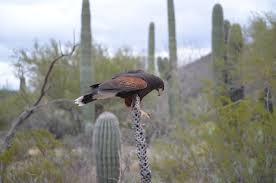 This terseness opens up to the third stanza’s longer sentence about Death Valley. While this sentence is broken across four lines, the phrasing is only interrupted in a natural way at the end by a list. Yet, the pace continues to change. The third stanza’s last line is an interrupted sentence, taken up by the fourth stanza. There is subtle momentum that brings the reader closer in attention to what is being detailed. This attention is rewarded by the final interruption of the last two lines; here, the action of hearing “flapping, swishing” wings interrupts the pacing in a way that doesn’t disrupt the sense of the poem. Instead, the action of these lines, and of the noticing and wording of them, ends the poem with a lyric turn reminiscent of haiku. We are left, like the speaker, listening close.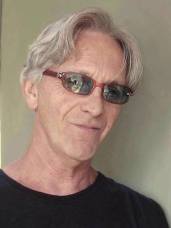
 I’m always fascinated by this idea of personal and creative negotiation and how it plays out across a poet’s work. This week, I’m sharing two poems by Barry Spacks. Both poems stood out to me in my reading of his book
  From the image of the “last tear” made of glass, the speaker begins an inventory of comparison images, each with its own metaphoric charge. The glass tear becomes “ice” that “doesn’t thaw”; then becomes a tooth; and so on. The eleven lines in which these images travel through pass by with such urgent enjambment, one is shook at the end by the rush of meaning and significance. This rush and tumble evokes the emotional tumult beginning for the boy in the poem, who himself is having to catch up with what has passed.
 Here, I’m moved by the turn from the outside world to the inner workings between two people. Not only is the natural occurrence put in terms of a relationship, it becomes conspiratorial. When the speaker notes “what secretly moves you, moves me” and makes it a suggestion from the earth itself, the far-off motion of a quake is juxtaposed with desire. Suddenly what is privately known is, for a moment, potentially exposed.